 |
1H2/X295/S
1A1/Y1.4/150/
1A2/Y150/S
4H2V/X36/S
|
4GV/X68/S
1A2T/Y350/S
1H1/Y1.4/100
4C1/Y300/S
|
 |
.jpg)

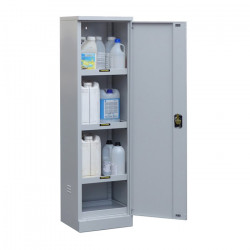
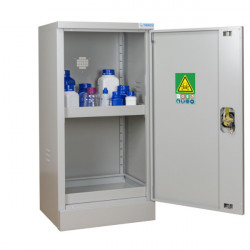
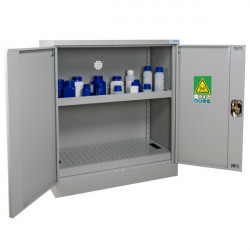
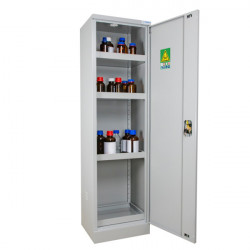
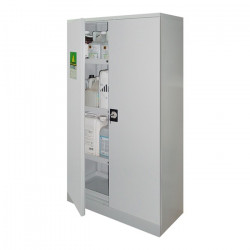
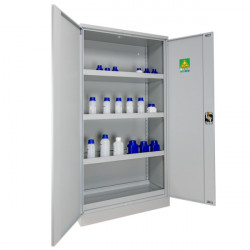
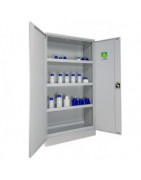 Pest Control Products Cabinet
Reminder of Safety Rules Regarding the Storage of Plant Protection Products
Pesticides must be stored away from farmyards and water sources, sensitive crops, residential areas, food storage areas (livestock feed, vegetables, etc.), areas where people gather, and power lines. The storage facility should be easily accessible to delivery trucks and for waste removal.
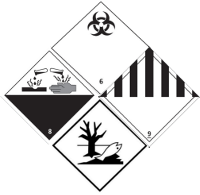
The storage area for plant protection products may take the form of a shed, a container, or a safety cabinet. They must be well-ventilated and kept locked (Article 4 of Decree 87-361 of May 27, 1987). The door must open outward, the floor must be leak-proof (retention floor, retention pallets, retention tray, etc.), and there must be adequate lighting. In addition, the electrical installation must comply with the NF standard C.15.100 and a sign must be posted on the door of the bungalow, container, or cabinet, including, in particular, safety instructions and standardized hazard pictograms... (Article R. 232-12-14 of the Labor Code and Article 10 of Decree 87-361 of May 27, 1987). Finally, a fire extinguisher must be provided outside the storage area (Article R. 232-12-17 of the Labor Code) and appropriate first-aid equipment must be available (Article R. 232-1-6 of the Labor Code).
How should you store pesticides properly?
• Store products by category and keep products that are incompatible with one another separate (Article R5132-68 of the Public Health Code).
• Identify and list the approved products currently in stock.
• Keep products in their original packaging (Article 3 of Decree 87-361 of May 27, 1987).
• Display the safety information contained in the safety data sheets (Article R. 521-53 of the Labor Code).
• Store only equipment intended for use in plant protection (Article 5 of Decree 87-361 of May 27, 1987).
• Have a sufficient amount of absorbent material on hand (e.g., an absorbent mat).
• Install a grating to keep the products separate from the containment tray.
• Equip the premises with first-aid supplies: eye wash station, first-aid kit, etc. (Rule 232-16 of the Labor Code).
• Display the emergency numbers for nearby locations (Rule 521-53 of the Labor Code).
• Store empty packaging in a collection bin for disposal by a specialized company.
• Store personal protective equipment and the supply of filter cartridges in a designated room (Article 8 of Decree 87-361 of May 27, 1987).
• Install a water supply and a safety shower nearby but outside the storage area (Article R. 232-1-6 of the Labor Code).
Current standards:
Decree No. 87-361 of May 27, 1987
Article 3: “Pest control products must be kept in their original packaging until they are used.”
Article 4: “Pest control products must be stored in a room designated for that purpose. This room must be well-ventilated. It must be locked if it contains pest control products classified as highly toxic, toxic, carcinogenic, teratogenic, or mutagenic. The employer must keep the key.”
Article 5: “Only equipment designated for use with pest control products may be used” ... “Utensils also designated for this use must be stored in a room as provided for in Article 4 above.”
Article 8: “Protective equipment must, after being cleaned, be placed in an individual locker designated solely for that purpose and located in a room other than the one referred to in Article 4 above.”
Article 10: “The employer must prohibit workers from snuffing, smoking, drinking, or eating during any exposure to pesticide products and before they have washed their bodies.”
Public Health Code
Article R.5132-66: “Hazardous substances or preparations” ... “shall be stored in locked cabinets or in rooms to which persons outside the facility do not have unrestricted access.”
Article R.5132-68: “Hazardous substances or preparations, as referred to in Article R. 5132-67 (classified as harmful, corrosive, or irritating), held for the purpose of placing them on the market or using them, shall be stored separately from other substances or preparations.”
| Ref | Description | External Dimensions H x W x D (mm) |
Interior Dimensions H x W x D (mm) |
Storage Capacity (Liters) | Retention Capacity: Liters | Number of shelves / bins | Maximum load per shelf (kg) | Weight (kg) |
| APC1P | 1-Door Countertop Pest Control Cabinet | 1000x500x420 | 930x480x390 | 70 | 20 | 2 | 30 | 26 |
| APC2P | 2-Door Countertop Pesticide Cabinet | 1000x920x420 | 930x900x390 | 135 | 40 | 2 | 50 | 40 |
| APH1P | Tall 1-door pesticide cabinet | 1800x500x420 | 1730x480x390 | 130 | 40 | 4 | 30 | 41 |
| APH2P | Tall 2-door pesticide cabinet | 1800x920x420 | 1730x900x390 | 240 | 80 | 4 | 50 | 60 |
| APK1P | 1-Door Plant Protection Cabinet (Kit) | 1800x500x422 | 1680x475x352 | 120 | 40 | 4 | 30 | 33 |
| APK2P | 2-Door Plant Protection Cabinet (Kit) | 1800x916x422 | 1680x891x352 | 220 | 80 | 4 | 45 | 55 |