


.jpg)

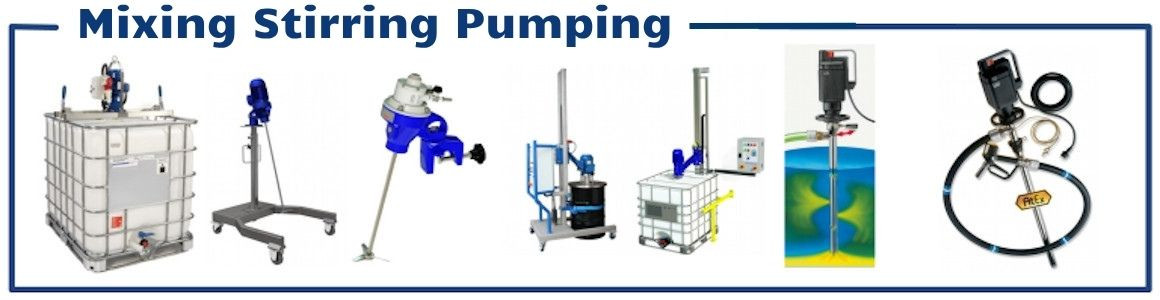

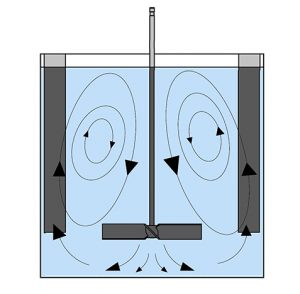
Choosing the right impeller is essential for optimum mixing performance. Many types of impeller are available, so how do you know which one suits your application? The answer depends on the process requirements and the physical properties of the fluid. Impellers fall into two main categories: axial-flow and radial-flow.
 |
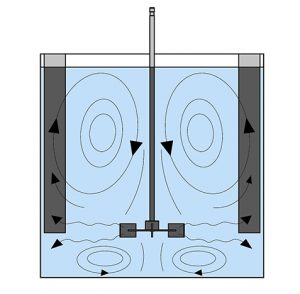 |
| Axial flow pattern | Radial flow pattern |
| Axial-Flow Impellers | ||
|---|---|---|
| Propeller (E-315) |
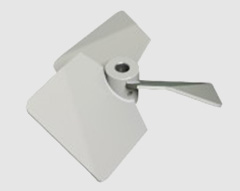 |
Propellers are one of the oldest types of impeller. Compact and highly efficient, they are well suited to portable mixers. The fabricated version shown on the left is more cost-effective to produce across a wide range of sizes. Viscosity up to 5,000 cP |
| Pitched-blade turbine (E-400) |
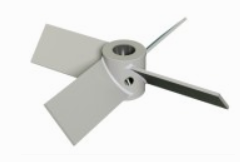 |
With blades pitched at 45°, the E-400 produces both axial and radial flow. It is used when a combination of flow and shear is needed, which makes it one of the most versatile impellers. Viscosity up to 25,000 cP |
| Hydrofoil (E-300) |
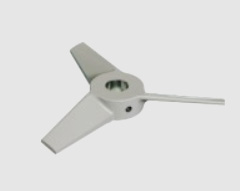 |
Hydrofoils were developed to produce more flow and less shear than the E-400. Their 3 or 4 tapered blades give improved axial flow, making them suitable for liquid blending and solids suspension. Viscosity up to 3,000 cP |
Radial-flow impellers, by contrast, discharge fluid sideways, perpendicular to the shaft. They give more shear and less flow than axial-flow impellers. Typical applications include gas–liquid and liquid–liquid dispersion. The table below shows the main radial-flow impellers with a short description.
| Radial-Flow Impellers | ||
|---|---|---|
| Rushton turbine | 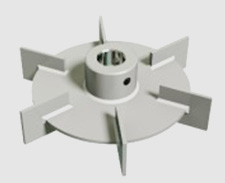 |
One of the first mixing impellers to be formally studied, the Rushton turbine consists of a flat disc carrying six vertical blades, designed for radial flow. Viscosity up to 10,000 cP |
| Smith turbine | 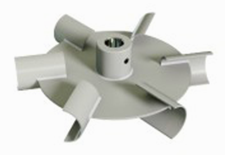 |
The Smith turbine was developed to improve on the efficiency of the traditional Rushton turbine. Its curved blades give better gas dispersion and a higher gas-handling capacity. Viscosity up to 10,000 cP |
Impellers for Very High Viscosity
Anchor and helical ribbon impellers are used for very high-viscosity fluids. They provide bulk mixing at low speed and low shear. Their diameter is close to that of the tank, with a small clearance to the walls. Applications include inks, paints and adhesives.
| Impellers for Very High Viscosity | ||
|---|---|---|
| Anchor / gate impeller | 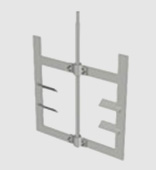 |
The anchor impeller works in laminar flow and produces mainly tangential and radial flow. The basic design can be fitted with inclined inner blades (gate impeller), as shown, to increase axial flow in the vessel. Viscosity range < 100,000 cP |
| Helical ribbon impeller | 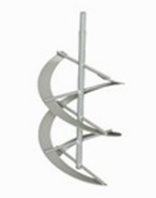 |
An alternative to the anchor, the helical ribbon impeller also works in laminar flow, but produces axial flow. Its larger contact area makes it suitable for viscosities up to 150,000 cP. Typical applications include creams, lotions and pastes. Viscosity up to 150,000 cP |
For difficult applications, an anchor and a helical ribbon can be combined: their flow patterns complement each other, giving better circulation and therefore better mixing.
Other Impellers
Other widely used impellers that do not fall into the categories above:
| Other Impellers | ||
|---|---|---|
| Sawtooth disperser | 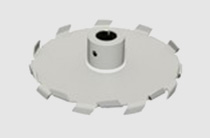 |
Sawtooth dispersers are designed to produce maximum shear. At high speed, they are used to incorporate a second phase and to produce emulsions. Viscosity up to 50,000 cP |
| Low-level “kicker” impeller | 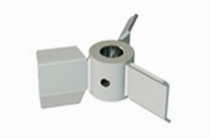 |
Kickers are small impellers, usually of the radial-flow type, fitted at the bottom of the vessel below the main impeller. They keep the contents mixed while the vessel is being emptied, or help slurries flow out of the vessel. |
| E-400 folding impeller |  |
The E-400 folding impeller has four blades pitched at 45° that fold down to pass through a narrow opening and open out when the mixer runs. It offers the same mixing performance as a standard pitched-blade turbine and is ideal for tanks with small openings, such as IBCs. Viscosity up to 25,000 cP |