


.jpg)








Relative density
Density (S.G.) is the ratio of a substance’s density to that of a reference substance. For liquids and solids, the reference substance is almost always water at 4°C, since its maximum density is 1 g/cm³.
With this in mind, the density of a fluid is the ratio of the fluid’s density to the density of water, as shown below:
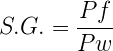 |
S.G. – Relative density of the fluid to be measured Pf – Density of the fluid to be measured (g/cm3) Pw – Density of water (g/cm3) |
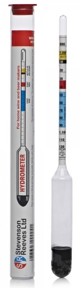
Hydrometer
A hydrometer is a device that can be used to directly determine the specific gravity of a fluid that does not require
just a small sample of the fluid.
By filling a cylindrical container with the fluid to be tested and placing the hydrometer in the container so that it is suspended in the fluid, the specific gravity of the fluid can be read from the point where the fluid’s surface touches the scale on the hydrometer.
For an accurate reading, make sure the hydrometer is fully suspended in the liquid—that is, that it does not touch the sides or bottom of the container—and that it has been properly calibrated. The hydrometer can be calibrated by using water as the test fluid under standard conditions at 4°C and verifying that the specific gravity (S.G.) reading is 1.
Calculation Using Density/Weight
Based on the definition of specific gravity, if we know the density of the fluid, we can directly calculate the fluid’s specific gravity by dividing that value by the density of water under the same conditions. Since density is equal to mass divided by volume, specific gravity can also be calculated by dividing the mass of the fluid by the mass of water for the same volume of fluid and water.
A mixture of several liquids with different densities
When several liquids with different specific gravities are mixed, the result is a new liquid with its own specific gravity, which is different from that of its components. The specific gravity of the mixture can be calculated as follows:
 |
S.G.i – Relative density of species i xi – Mass fraction of species i |
As an example, let’s consider two liquids, A and B, where A has a specific gravity of 1.0 and B has a specific gravity of 1.5, and they are mixed together in a 2:3 ratio by weight, meaning that 40% of the product consists of A and the remaining 60% consists of B.
The product's S.G. can be calculated as follows:.png "Latex formula")
Effect on the mixture
It is important to know the specific gravity of the liquids to be mixed in order to determine which type of mixer to use. This is because the specific gravity of the liquids affects the power required to achieve proper mixing.
For Newtonian fluids, as S.G. increases, the power required for mixing also increases. Consequently, if S.G. is not taken into account when determining the type of impeller and gearbox required for the mixer, the power requirement is likely to be underestimated, which could result in damage to the mixer.
Liquid-Liquid Mixture
In applications where two or more liquids must be mixed, the difference in specific gravity can be a significant factor. Even if the two components are miscible, if there is a large difference in specific gravity, they will tend to separate into two distinct layers. If one of the components has a lower specific gravity than the other, it will tend to float on top of the bulk of the fluid and will be difficult to incorporate into the product. If the product has a higher specific gravity, it will tend to sink to the bottom and will again be difficult to incorporate into the bulk liquid.
The greater the difference in specific gravity between two components, the greater the mixing intensity required to blend them effectively. Mixing can also be facilitated by adding a second impeller near the top of the fluid level, which is used to intentionally create a small vortex. This draws the lighter component from the surface of the fluid into the main mass.
A similar result can be achieved by using a low-level “kicker” turbine located at the bottom of the reservoir to inject the heaviest component
in most of the fluid.
Solid/Liquid Mixture
In solid-suspension applications, differences in specific gravity can cause even greater problems. If the solids do not dissolve in the fluid, the mixer must work constantly to keep the solids suspended in the liquid. This may require high-intensity agitation, with large motors and high impeller speeds needed to ensure the solids remain suspended.
As with liquid-liquid mixing, placing a second impeller at the top of the mixing tank can help draw lighter components into the main body of the fluid, where the main impeller can disperse them throughout the liquid. Low-level kicker impellers can also be used to remove heavy solids from the bottom of the tank, where they are more easily entrained in the flow from the main impeller and carried along with the bulk fluid.
Brix Scale (°bx)
A common way to indirectly measure the specific gravity (SG) of a fluid is to use the fluid’s Brix degrees. One Brix degree (1°Bx) is defined as 1 gram of sucrose in 100 grams of aqueous solution. For fruit juice concentrates and other sweetened products, the sugar content is typically provided by the manufacturer, which makes it possible to determine the fluid’s specific gravity.
Background
Named after the 19th-century scientist Adolf Brix, the Brix scale was originally designed for brewers to determine the sugar content of their product. The brewer must first measure the density of the product and then, using a set of published data tables, look up the equivalent sucrose concentration expressed as a percentage by mass. The data were collected by preparing pure sucrose solutions of known concentration and measuring their density and mass percentage of sucrose.
Today, the Brix scale is still used by industries such as sugar, winemaking, and fruit juice production as a means of comparison
of the relative sugar content.
Conversion Between Brix and Density
For the purpose of designing a mixer, we would like to convert the Brix value to specific gravity, which can be done using the original conversion tables.
or using the formula below:
|
Conversion from Brix (°bx) to Specific Gravity (S.G.): |
.png)
|
|
Conversion of density (S.G.) to Brix (°bx): |
.png "Latex formula")
|
Note that these are empirical relationships and should not be used for values greater than 40° bx or 1.18. S.G.
Plot of Brix degrees vs. density |
|
| Specific Gravity | 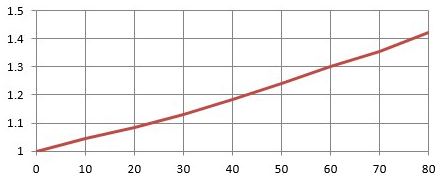 |
|---|---|
| Brix degrees |
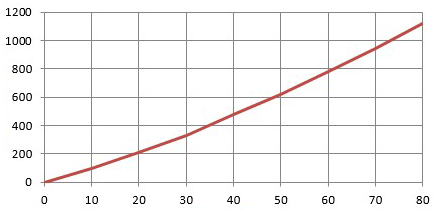
Brix Content vs. Sugar Content |
|
| Sugar content (g/L) |
 |
|---|---|
| Brix degrees |