


.jpg)

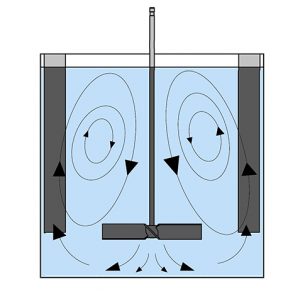
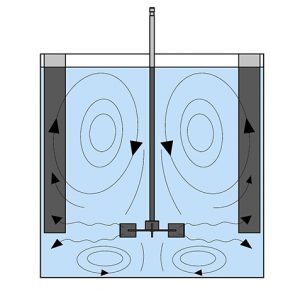
Choosing the right impeller for your mixing application is vital to achieving optimal performance. There is a wide variety of impeller types available on the market, but how do you know which one is best suited for your application? To determine the best choice, understanding the process requirements and the physical properties of the fluid is of paramount importance. Impellers can be classified into two main categories: axial and radial.
 |
 |
|
Axial flow regime |
Radial flow regime |
| Axial-Flow Turbines | ||
|---|---|---|
| Propeller (E-315) |
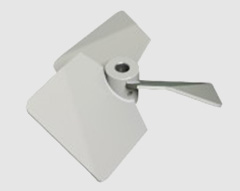 |
Propellers, one of the oldest types of impellers, have long been used on boats and are well-suited for portable mixers due to their small size and high efficiency. The manufactured variants shown on the left are more cost-effective to produce across a wide range of sizes. Viscosity up to 5,000 cP |
| Angled-blade propeller (E=400) |
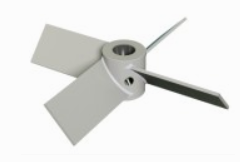 |
E400 propellers are generally used when a combination of axial and radial thrust is required, due to their characteristic 45° angle, which results in both axial and radial thrust characteristics. This makes them one of the most versatile propellers. Viscosity up to 25,000 cP |
| Hydroptère (E=300) |
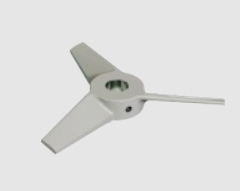 |
The hydrofoils were developed to produce higher flow rates and lower shear stress compared to the E400 models. They have 3–4 conical blades that produce improved axial flow, making them suitable for mixing liquids and suspending solids. Viscosity up to 3,000 cP |
Radial-flow impellers, on the other hand, feature lateral flow—that is, flow perpendicular to the impeller shaft. They are known to provide more shear and less flow compared to their axial counterparts. They are therefore larger, operate at slower speeds, and are used for higher-viscosity products. Typical applications include gas-liquid and liquid-liquid dispersions. The table below presents the main examples of both types of impellers along with their general descriptions.
| Radial Propellers | ||
|---|---|---|
| Rushton turbine | 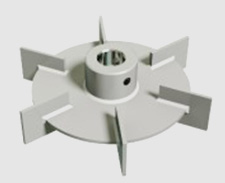 |
The Rushton turbine, one of the first mixing-type turbines to be formally studied, consists of a flat disk that maintains a constant pressure difference on either side of the turbine, with six vertical blades designed for radial flow. Viscosity up to 10,000 cP |
| Smith Turbine | 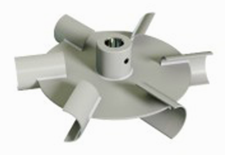 |
The latest Smith turbine was developed to improve upon the efficiency of the traditional Rushton turbine. The curved blades provide better gas dispersion and gas retention than the Rushton turbine. Viscosity up to 10,000 cP |
Very High-Viscosity Impellers
Helical or screw-type impellers are used for very high-viscosity fluids and enable macroscopic mixing at low speeds and low shear rates. These impellers are typically the same size as the tank, with the impeller flushing against the walls. Applications include inks, paints, and adhesives.
| Very High-Viscosity Impellers | ||
|---|---|---|
| Blade Propeller | 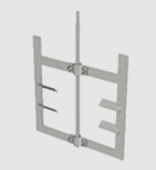 |
The vane impeller operates under laminar flow conditions and generates a predominantly radial flow. The basic design can be modified to include inward-angled blades, as shown in the illustration, to generate greater axial flow within the mixing vessel. Viscosity range < 100,000 cP |
| Helical Propeller | 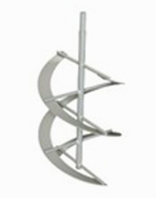 |
An alternative to the paddle impeller is the helical impeller, which also operates under laminar conditions but in an axial flow configuration. Because they have a larger contact surface area than paddle impellers, they are suitable for viscosities up to 150,000 cP. Typical applications include creams, lotions, and pastes. Viscosity up to 150,000 cP |
Occasionally, for challenging applications, a combination of a paddle impeller and a helical impeller may be used because the two flow patterns complement each other, resulting in greater circulation and, therefore, better mixing.
Other Propellers
Other types of impellers that do not fall into any of the above categories but are still widely used in mixing applications are listed below:
| Other Turbines | ||
|---|---|---|
| Sprocket | 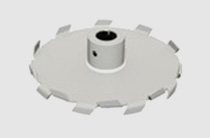 |
Serrated wheels are designed to produce the maximum possible shear. When operated at high speeds, they are used to incorporate a second phase and to produce emulsions.
Viscosity up to 50,000 cP |
| “Kicker” Tank-Bottom Propeller | 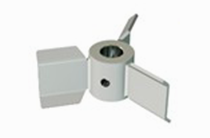 |
“Kicker” tank-bottom propellers are typically small, conventional propellers, usually of the radial flow type. These kickers are installed at the bottom of a mixing vessel, below the main impeller, to ensure continuous mixing while the vessel is being emptied or to help slurry flow out of the vessel. |
| E-400 Folding Propeller | .gif) |
The E-400 foldable propeller has four blades angled at 45° that fold downward when not in use. As a result, they offer mixing characteristics similar to those of standard angled-blade propellers and are ideal for applications with small tank openings, such as IBCs.
Viscosity up to 25,000 cP |